
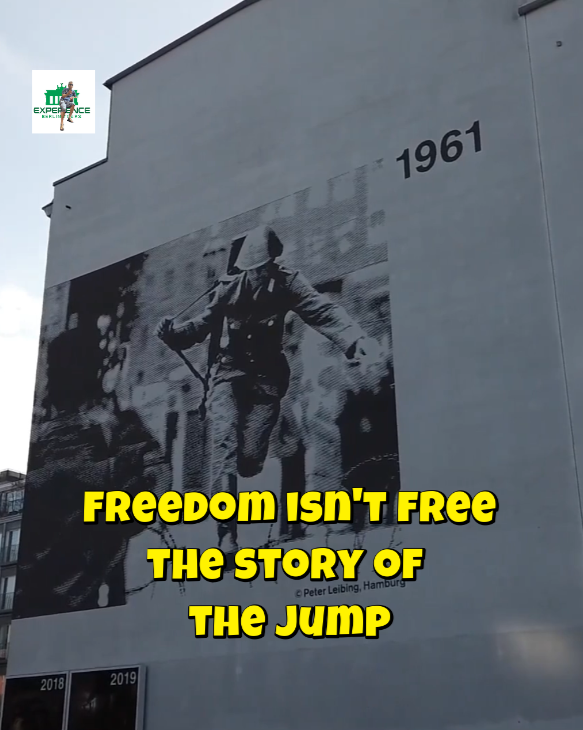
If you are standing inside of the Berlin Wall Memorial, at the intersection of Bernauer Straße and Brunnen Straße, you are very near where one of the most famous escape attempts took place.
Look up at the mural. That young man frozen mid-air is Conrad Schumann, an East German border guard stationed nearby in August 1961, during the very first days of the Berlin Wall.
Schumann was just 19 and from Saxony, Germany.
He’d been ordered to Berlin to help seal the border, but he was deeply conflicted—frightened, unsure, and horrified watching families suddenly split apart.
West Berliners across the street saw him pacing nervously and began quietly encouraging him: “Komm rüber! Jump!”
West Berlin police sensed something was about to happen. They eased a patrol car toward the wire to give him cover.
And photographer Peter Leibing, tipped off that “something might happen,” positioned his camera toward this spot.
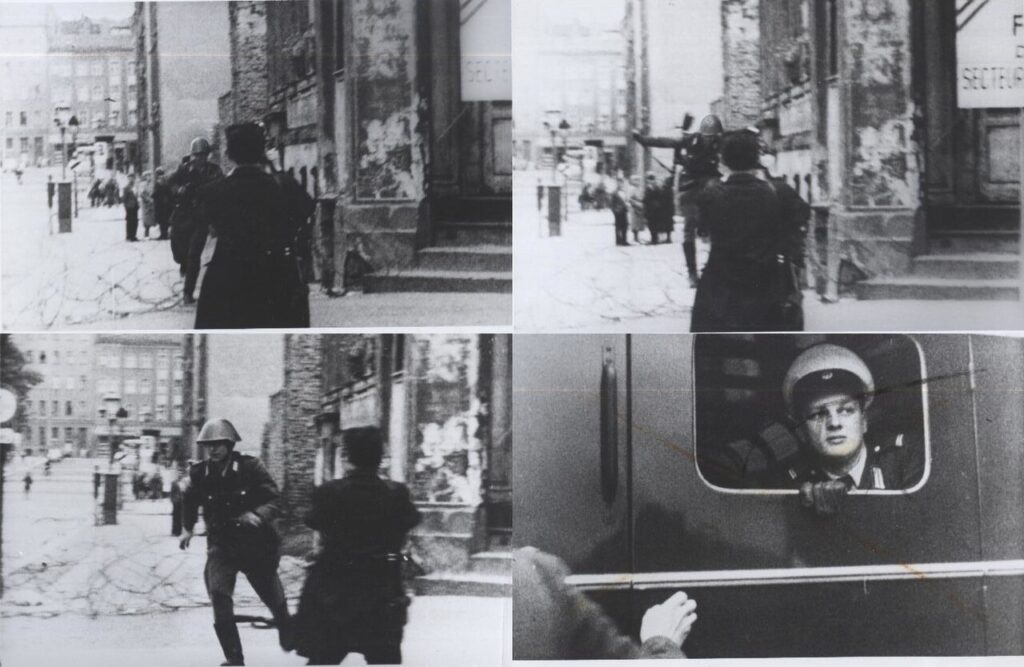
Then, Schumann saw a tiny gap in the East German guards’ attention.
Suddenly, he leapt over the barbed wire, in a moment captured in one of the most iconic photos of the Cold War.
After the escape, he built a quiet life in Bavaria, working in a factory.
But the pressure of being a symbol and the guilt of leaving family and friends behind never fully left him.
In 1998, at just 56 years old, Conrad Schumann died by suicide.
It’s a different but important take on the phrase “freedom isn’t free.”
The mural is located one block to the west of the actual location of the jump.
Today, the corner isn’t recognizable, as all of the buildings here were torn down to make way for the Berlin Wall barrier system.
But there is an information board commemorating his jump here.